
Your website traffic is dropping. Your rankings look fine. So what is going on?
A huge number of people no longer click search results. They ask ChatGPT. They use Google’s AI answers. Users type their queries into Perplexity and receive a complete summary immediately. That is where generative engine optimization comes in. By 2026, understanding certain skills becomes crucial if you manage a website or work in digital marketing. This guide explains what GEO is, its importance, and steps you can take immediately.
What Is Generative Engine Optimization?
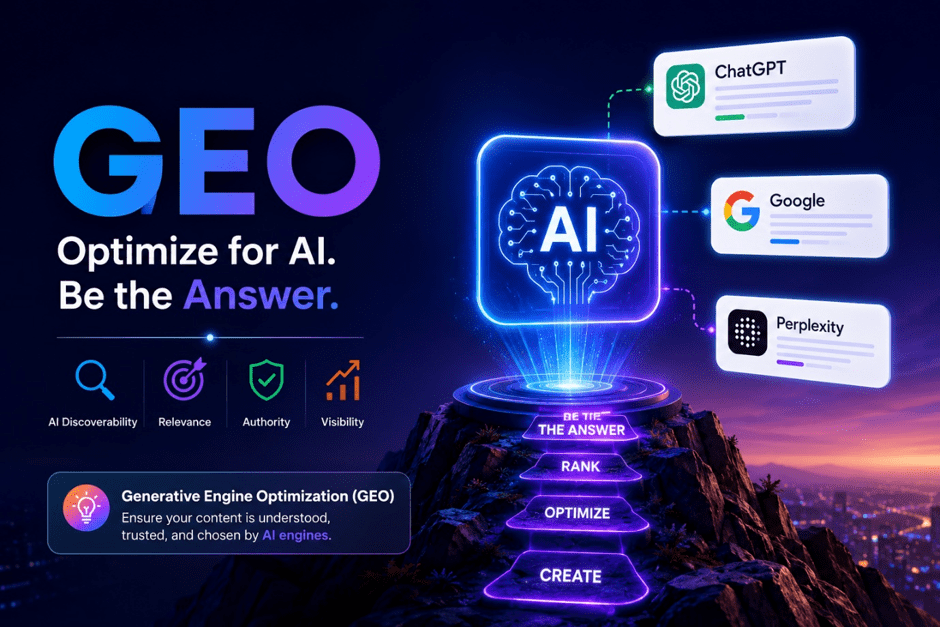
Generative engine optimization is the process of writing content so AI tools choose it when building their answers.
When someone asks ChatGPT or Perplexity a question, those tools pull from real web pages. They judge whether a page is clear and trustworthy, then use the best sources in their response. GEO is about making your content one of those sources.
Old SEO was about ranking so a person would click your link. GEO is about getting an AI to reference your page even when no click happens at all. It has been demonstrated in 2023 through research conducted at Princeton University and Georgia Tech. They studied many writing formats and found out that the more comprehensible and coherent the article written by you was, the higher its citation rates with AI. The field has even gotten its name.
To stay up-to-date with developments and trends on how AI impacts content and search, [PremiumTechBlog](https://premiumtechblog.com/) is an excellent place to start.
How AI Tools Pick Their Sources
When someone types a question into Perplexity or Google, the AI does a live scan of web pages. It checks three things:
- Does this page answer the question directly?
· Is writing clear and concise?
· Is this resource credible?
If your page checks all three, there is a solid chance the AI quotes it. If your content is vague or difficult to read, the AI moves on.
Google’s AI Overviews work the same way. They show up at the top of most informational searches. Getting cited there is often more valuable than ranking third on the page—because most people read the AI answer first and never scroll further.
GEO vs. SEO Do You Need Both?
Yes. Both matters, and they work together well.
SEO gets your page in front of people searching Google. GEO gets your content used by AI tools that answer questions. The audience is different, but the core skills overlap.
Good writing helps both. Clear structure helps both. Being a trusted source helps both. GEO just adds a new type of reader to keep in mind.
Put it simply: SEO wins the click. GEO wins the citation. Websites that do both stay visible no matter how people search in 2026. PremiumTechBlog covers exactly where SEO and geo connect useful if you want the full picture.
Why GEO Matters Right Now
AI search is not a niche trend. This is how tens of millions of people obtain information every day. Daily active users reached 15 million for Perplexity by the end of 2024. Google runs AI Overviews on most informational searches. Microsoft built Copilot into Windows, Office, and Edge. These tools are everywhere.
For website owners, this creates a real problem. If an AI tool answers a question in full, that person never visits any website. No click happens not for you, not for anyone.
This is not a future issue. It is happening right now. Websites that ignore generative engine optimization will keep losing traffic even when their Google rankings look perfectly fine.
4 GEO Strategies You Can Use Today
GEO does not mean rebuilding your whole site. A few focused changes to how you write go a long way.
1. Put the Answer First
AI tools look for direct answers, so give them one right at the top. Skip the warm-up. State the answer in the first one or two sentences, then explain below.
If your page covers generative engine optimization, say what it is immediately. Do not save the definition for paragraph four. This one change alone can improve how often AI tools pull from your content.
2. Write Like a Real Person
Short sentences. Common words. Clear ideas. AI tools favour natural writing over stiff corporate text. If you would not say it out loud to a friend, cut it from your article.
3. Use Real Facts and Numbers
Vague claims get skipped. Specific facts build trust.
Do not say “many businesses use AI tools.” Say “Perplexity reached 15 million daily users in 2024.” Real numbers and concrete examples make your content more credible to readers and AI tools alike.
4. Organize with Clear Headers
Use H2 and H3 headings throughout every page. Keep paragraphs short. Break big ideas into numbered steps or short lists when it makes sense.
AI tools scan fast. Structure helps them find the exact part that answers a question. A well-organized page gets cited far more than a wall of text.
For more practical writing tips that work in 2026, PremiumTechBlog has guides made for real website owners.
How to Know If GEO Is Working
There is no single dashboard yet that tracks all your AI citations. But these three checks give you a useful picture:
Test your own questions. Go to Perplexity or ChatGPT and search the questions your pages target. See which sources appear. Is your site one of them?
Watch impressions vs. clicks. In Google Search Console, if impressions rise while clicks stay flat, AI Overviews are likely pulling from your content. You are getting cited just not always clicked.
Monitor brand mentions. Tools like Brand24 can identify when your website is mentioned in AI-generated content online. Check these often to understand if your GEO work is effective.
Frequently Asked Questions
What is generative engine optimization, simply put?
It involves crafting content so AI tools like ChatGPT, Perplexity, and Google refer to it when answering user queries.
How is GEO distinct from SEO?
SEO helps users find your site in search outcomes. GEO aids AI tools in using your content for their answers. An effective strategy combines both.
Which content is best for GEO?
How-to guides, FAQ pages, definition articles, and comparison pieces are most effective. These align with questions frequently asked of AI tools.
Do I need to rewrite my entire site?
No. Begin with your main pages. Add a clear answer at the beginning, adjust the structure, and include one solid fact. This is often sufficient to notice early results.
Start With One Page Today.
GEO comes down to two things: be clear and be credible.
Pick one page on your site. Write the answer to its main question right at the top in plain language. Clean up the headings. Add one real fact. Then go to Perplexity and search that question.
If you show up, do the same on your next page. If you do not study which sources did appear and learn from what they did differently.
AI search keeps growing. Websites that understand generative engine optimization today will have a clear edge over those that wait.
Stay ahead of AI, SEO, and what is changing on the web. Visit PremiumTechBlog for plain-language guides built for real website owners.